Short Brothers was one of the largest designers and manufacturers of multi-engine flying boats. In the 1930s, as all-metal monoplanes began to replace biplanes, Short Brothers designed a series of civilian four-engine flying boats—the S.23, S.30, and S.33 models, known as the «C-Class» or «Empire Class.» Some of these were fitted with military equipment and used in combat.
The experience gained during the production and operation of these boats became the basis for the development of a long-range flying boat for maritime patrol and anti-submarine missions. The prototype first flew on 16 October 1937 as the Sunderland Mk.I. During operation, the aircraft was improved. The next version of the Sunderland Mk.II received an upper turret and more powerful Pegasus Mk.XVIII engines. Some of them were experimentally equipped with ASV Mk.II radars.
The Sunderland Mk.III/IIIA received a modernized fuselage (with a redesigned hull step) and ASV Mk.III radar in teardrop-shaped fairings under the wings. Later versions had four fixed machine guns in the nose to combat anti-aircraft gun crews on submarines. A total of 456 aircraft were built.
The final version of the Sunderland, the Mk.V, was powered by American P&W R-1830-90B engines. The armament was similar to the Mark III, but the Mark V was equipped with a new centimetric ASV Mark VIC radar, which was also installed on some of the last production Mark IIIs. Production continued until June 1946 (155 units). The new engines provided better performance without any real loss of range – the Sunderland could stay aloft if two engines on one wing failed, whereas the standard Mark III would constantly lose altitude.
The Sunderland entered service in 1938. During the war, these aircraft operated over the Atlantic, Indian and Pacific oceans – from the Arctic to the tropics. German pilots nicknamed it the “Flying Porcupine” for its powerful defensive armament.
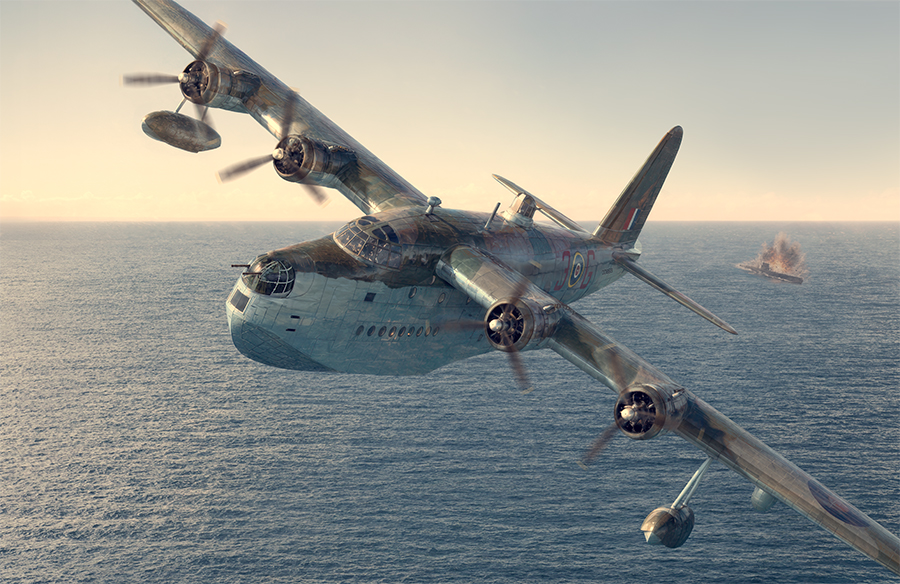
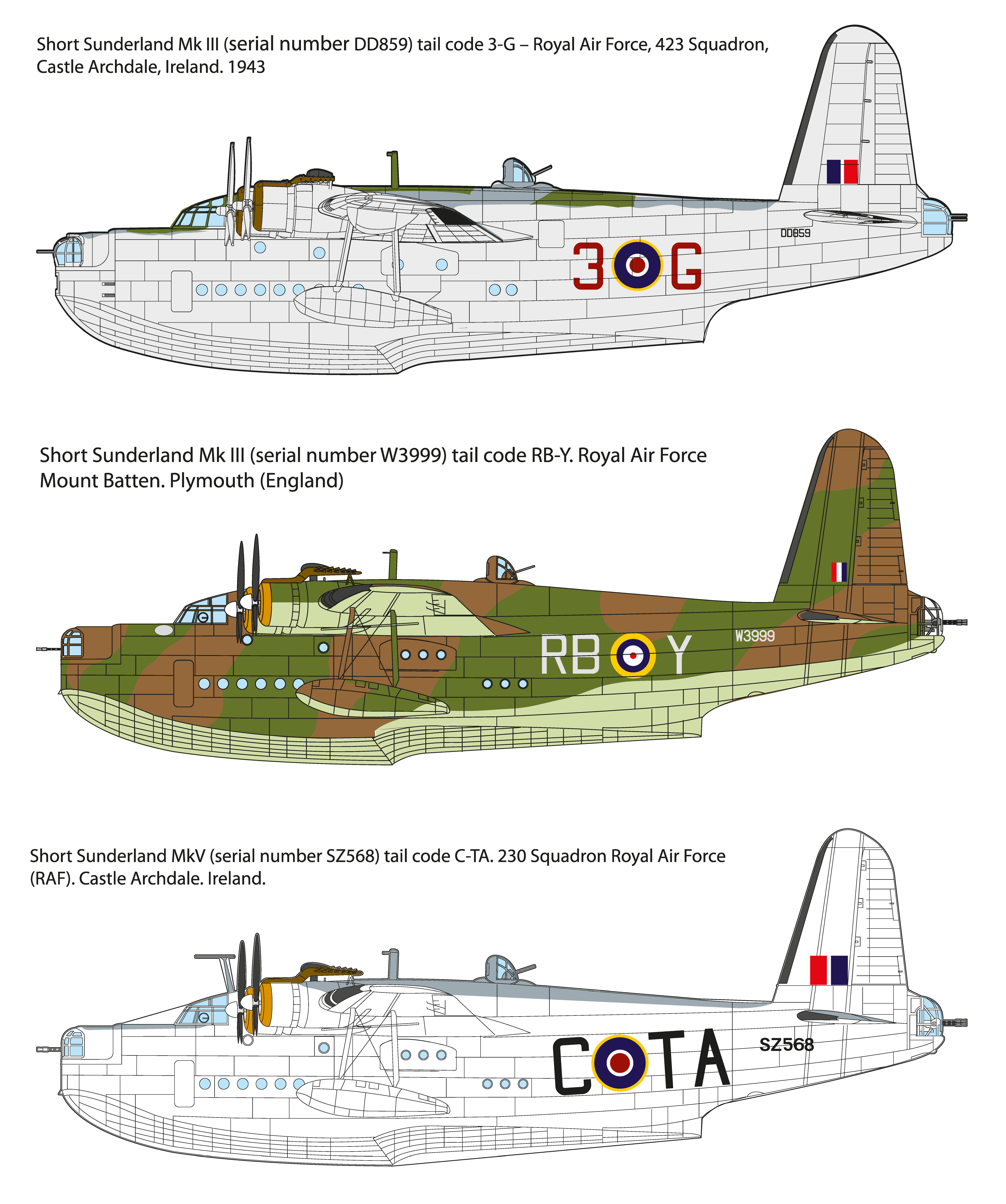
The Sunderland played a critical role in the Battle of the Atlantic, destroying around 28 German submarines and helping to sink seven more, earning it the nickname of «U-Boat Killer». A Short Sunderland Mk.III (code 3G) with the tail number DD859, under the command of Flying Officer Albert Bishop, sank the German Type XIV supply submarine U-489, known as a «Milchkuh» (Milk Cow), on 4 August 1943.
After World War II, the Short Sunderland played a unique and critical role in the Berlin Airlift, transporting vital materials to the city.
The Sunderland also saw combat during the Korean War and in operations in Malaysia. The last of the Royal New Zealand Air Force’s aircraft were not decommissioned until 1967.
The Sunderland was also used in civil aviation. In late 1942, the British Overseas Airways Corporation (BOAC) purchased six Sunderland Mark IIIs and adapted them for mail transport with primitive facilities for seven passengers to Nigeria and India. BOAC received more Mark IIIs and gradually developed better facilities for 24 passengers, including sleeping accommodation for 16. This conversion was called the Hythe; by the end of the war, BOAC had 29 Hythes. Another civil conversion of the Sunderland was the post-war Sandringham. Civilian versions of the aircraft were used for passenger transport until 1974.
|