Boeing VC-137C
Air Force One "Flying White House"
- Kit number
- 342
- Scale
- 1:144
- Category
- Aircraft
Technical specifications
- Performances
- Wingspan
- 44.42 m
- Length
- 46.61 m
- Height
- 12.73 m
- Wing area
- 283.35 m2
- Empty weight
- 78000 kg
- Max. speed
- 853 km/h
- Range of flight
- 3847 km
- Engines
- 4 turbofan Pratt and Whitney TF33-PW-100A
Similar kits
History
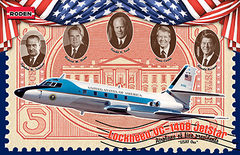
SAM 26000 was the first of two U.S. Air Force Boeing VC-137C aircraft specially configured and maintained for use by the President of the United States. It used the call sign "Air Force One" when the President was on board; otherwise, it used "SAM 26000" (pronounced "SAM two-six-thousand"), with "SAM" standing for Special Air Mission. The VC-137C with Air Force serial number 62-6000 (SAM 26000) was a specially designed Boeing 707. It entered service in 1962. The aircraft was built at the Boeing plant in Renton. Raymond Loewy, working with President Kennedy, designed the blue-and-white color scheme featuring the presidential seal, which is still in use today. The aircraft served as the primary transport for three presidents: Kennedy, Lyndon B. Johnson, and Richard Nixon. John F. Kennedy was the first president to use SAM 26000, flying on the aircraft for the first time on November 10, 1962, to attend the funeral of former First Lady Eleanor Roosevelt in Hyde Park, New York. SAM 26000 carried Kennedy to Berlin in June 1963, where he delivered his famous "Ich bin ein Berliner" speech. The month before, the aircraft had set 30 speed records, including a new record for the flight time between Washington and Moscow. It was designer Raymond Loewy who, at the invitation of First Lady Jacqueline Kennedy, gave SAM 26000 the now-familiar Air Force One livery of blue, silver, and white. President Johnson was SAM 26000’s most frequent passenger, flying over 523,000 miles on the Boeing VC-137C during his five years in office; he once referred to it as "my own little plane." The cabin interior underwent changes: new seats were installed, now facing rearward toward the presidential cabin. Inside the cabin itself, a spacious leather armchair (dubbed the "throne") and a crescent - shaped table were installed; the President could raise and lower the table using a switch. Assistants and guests sat on sofas surrounding the "throne." Johnson flew to Vietnam twice aboard SAM 26000 and visited Asia in 1968 and 1969. In 1967, Johnson embarked on unplanned aerial odyssey, making stops in California, Hawaii, Australia, Thailand, South Vietnam, Pakistan, and Italy. Following Richard Nixon's inauguration in 1969, the Boeing VC-137C SAM 26000 underwent refurbishment and modernization. Nixon redesigned the aircraft's interior to suit his preferences, abandoning the open-plan layout of the Johnson era in favor of a three-room suite for himself and his family that served as a combination living room, office, and bedroom. Accommodations for guests, assistants, security personnel, and the media were located aft of these three rooms. Although SAM 27000 became the primary presidential aircraft in 1972, Nixon preferred SAM 26000 because its interior layout offered greater privacy for the First Family. Nixon also named the aircraft "Spirit of '76," a name painted on the nose of both VC-137C aircraft. In 1972, the Nixons flew to China aboard SAM 26000, becoming the first U.S. president and first lady to visit the country. SAM 26000 was also used by National Security Advisor Henry Kissinger during his secret meetings with the French to negotiate the Vietnam peace process. In May 1998, SAM 26000 was delivered to the National Museum of the U.S. Air Force at Wright-Patterson Air Force Base near Dayton, Ohio. Its final flight took place over the museum grounds for the benefit of the media and museum visitors. The aircraft made several low-altitude passes over the museum before finally landing on the original Wright Field runway adjacent to the museum. In December 2009, SAM 26000 was removed from display and moved to the museum's restoration area, where it was repainted in the presidential livery. SAM 26000 was later returned to the museum's presidential aircraft hangar.